
Corrugated Stainless Steel Tubing (CSST) is a flexible, stainless steel pipe that is used to supply natural gas in residential, commercial, and industrial structures. CSST is recognizable by the yellow plastic coating on the exterior of the tubing. More than one billion feet of CSST piping have been installed in millions of homes since its introduction to the United States in the 1990’s.
The biggest advantage to using CSST over other types of pipe is that it is flexible.
 This flexibility allows it to be routed under, through, and along joists in your basement or attic, and inside the walls in your home. Running Corrugated Stainless Steel Tubing gas line is similar to running wiring in that you can run one long continuous length of it without having to make multiple connections. This makes it much quicker and simpler to install, and fewer connections mean less potential for leaks.
History of CSST
CSST was invented in Japan in the 1980’s as an alternative to solid gas lines. Due to the high degree of seismic activity in Japan, they were searching for a gas supply line that would be flexible enough to allow gas appliances to move and flex during earthquakes without the gas lines leaking or rupturing. Out of this search, CSST was born. Then in the 1990’s, plumbers began using Corrugated Stainless Steel Tubing in the US, and it became more popular due to its ease of installation, which led to it being installed in more and more homes.
What is the problem with CSST?
Not too long after Corrugated Stainless Steel Tubing began to be used in the United States, several house fires were blamed on the CSST pipe installed in those homes. According to investigators, lightning strikes created very small holes in the CSST piping. These holes resulted in gas leaks which in turn caused the fires.
Lightning strikes can create high voltages in metallic materials such as CSST even if the lightning does not strike the house directly.
All the lightning has to do is create a high voltage near the home which will travel through the ground and onto the home’s gas supply system which is buried. This will create a high voltage on the gas line throughout the home.
Because Corrugated Stainless Steel Tubing is so thin, it is much more susceptible to damage than other materials that are commonly used to carry gas in homes. Its thickness is about equal to the thickness of four pieces of paper. Once the high voltage has reached the gas pipe, it will instantaneously do one of two things:
1) it will either dissipate back into the ground, or
2) if there is a grounded piece of metal nearby (i.e. something at a lower voltage that will allow the high voltage to get to a place of lower voltage), the high voltage can arc across to that piece of metal.
Examples of things that can allow arcing to occur are electrical wiring, coaxial cable, a furnace, and metal ductwork. Anything near the CSST that is conductive and grounded, can give the high voltage a path to ground (zero volts) after it has arched from the CSST pipe.
The arcing of high voltage from Corrugated Stainless Steel Tubing is similar to how you can be shocked by touching a metal doorknob after walking across a carpeted floor. (You actually don’t get shocked when you touch the doorknob. You get shocked when your hand gets close enough to the knob to allow the electricity to arc through the air from your hand to the doorknob.) The shock that you feel is the heat of the arc.
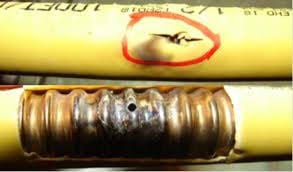
The high voltage caused by a lightning strike is at a higher voltage and can carry much more current than when you touch a doorknob. Due to the higher voltage, it can travel further through the air and is much more powerful than the electricity built up in your body that arcs when you touch the doorknob. As the high voltage in the Corrugated Stainless Steel Tubing discharges by arcing from the CSST to some other nearby piece of metal, the spark produced is very hot and can melt a small hole through the thin CSST tubing. Because the CSST is carrying flammable gas, a potentially very dangerous situation is created. Below is a photo from https://www.jnrplumbing.com/bonded-gas-lines-and-csst/ that shows some CSST that was damaged by arcing.
How Dangerous is CSST?
The debate about the danger level of CSST gas lines is ongoing. It seems clear that at least some fires have been caused by CSST piping in the home, and some deaths and/or injuries have resulted from these fires. On the other side of the coin, the pro-CSST website (https://www.csstfacts.org/faq/) states the following, “No. There have been no deaths or injuries caused by CSST piping.”
The number of house fires caused by Corrugated Stainless Steel Tubing is relatively small, despite the fact that it has been installed in millions of homes. According to the National Fire Protection Association (NFPA), there are between 300,000 and 400,000 house fires in the US each year. Current statistics show that only about 1% of these fires are caused by lightning. Since less than half of lightning-caused fires are blamed on CSST, the facts seem to show that the number of fires caused by Corrugated Stainless Steel Tubing is very low compared to the total number of house fires. Some studies show that while Corrugated Stainless Steel Tubing does present a risk to your home, it is not a big risk.
I believe that there are many other things that put your home at a greater risk of fire than CSST does.
I don’t think it can be definitively determined exactly how many deaths or injuries have resulted from CSST in the home, but I believe that it is a relatively small number. It seems clear that Corrugated Stainless Steel Tubing can be a safe alternative to the more common solid-gas piping that has been used for years in millions of homes and other buildings. CSST piping should be safe to use as long as it is installed properly.
Making Corrugated Stainless Steel Tubing Piping Safe
Over the years, several things were attempted to protect homes from the risks of CSST. One solution was a complete ban of Corrugated Stainless Steel Tubing by some municipalities and states. (Most, if not all, of these bans have been lifted.) Finally, in 2006, a solution was developed that entailed electrically bonding the CSST. Bonding has been required for all Corrugated Stainless Steel Tubing installations since 2007. The purpose of the bonding is to prevent the high voltages from building up in the gas line.
Studies have shown that bonding the CSST has lowered the number of house fires caused by lightning, but it has not totally eliminated these fires.
What it Means to Bond CSST Piping
Part of installing CSST piping safely includes ensuring that it is electrically bonded. Bonding means to ensure a good path for any stray voltages to dissipate to the ground rather than building up in a piece of metal. Below are some examples of bonding.
- Bonding is used to keep swimming pool equipment at zero volts in order to prevent electrocutions around pool equipment.
- Bonding is used in other places in the home and on industrial equipment to keep people and equipment safe by keeping equipment at zero volts.
- Bonding is also used to prevent voltage from building up in CSST piping in order to help keep homes and people safe.
How to Bond CSST Piping
Bonding is accomplished by connecting a wire to the home’s gas system and running it to the home’s grounding electrode system. The bonding wire can be connected to the gas system either inside or outside the home, but it must be in an accessible location. It must be connected to the gas piping before the first run of CSST, but it should never be connected directly to the CSST piping itself. The purpose of connecting the bonding wire before the CSST is to allow it to dissipate the voltage before it ever reaches the Corrugated Stainless Steel Tubing.
The purpose of this post is not to show you how to bond your CSST piping, but to give you some general information about bonding and why it is important. Since proper bonding is critically important to a safe installation, it should always be performed by a licensed electrician. Here is a link to some detailed information about bonding CSST if you would like to read more about bonding. (https://cdn-web.iccsafe.org/wp-content/uploads/membership_councils/CodeNotes_2015IFGC.pdf)
What is the difference between yellow and black Corrugated Stainless Steel Tubing?
While CSST is normally coated with a yellow plastic coating, some Corrugated Stainless Steel Tubing tubing has a black coating. Yellow coloring has commonly been used on most gas lines simply to indicate that they are gas-carrying piping. This convention was followed when CSST was first introduced in this country in the 90’s. A black coating is used to indicate that the coating is a protective-jacket that is designed to provide some protection against electrical arcing caused by lightning strikes. Black-jacketed Corrugated Stainless Steel Tubing is referred to as ‘arc-resistant CSST’ and has met a baseline lightning arcing test incorporated into the CSST product performance standard (ANSI LC 1). (http://csstsafety.com/CSST-FAQs.html) Both yellow and black CSST are available commercially.
How to know if you have CSST in your home?
If your home was built or remodeled after 1990, then it is possible that it contains CSST gas lines.
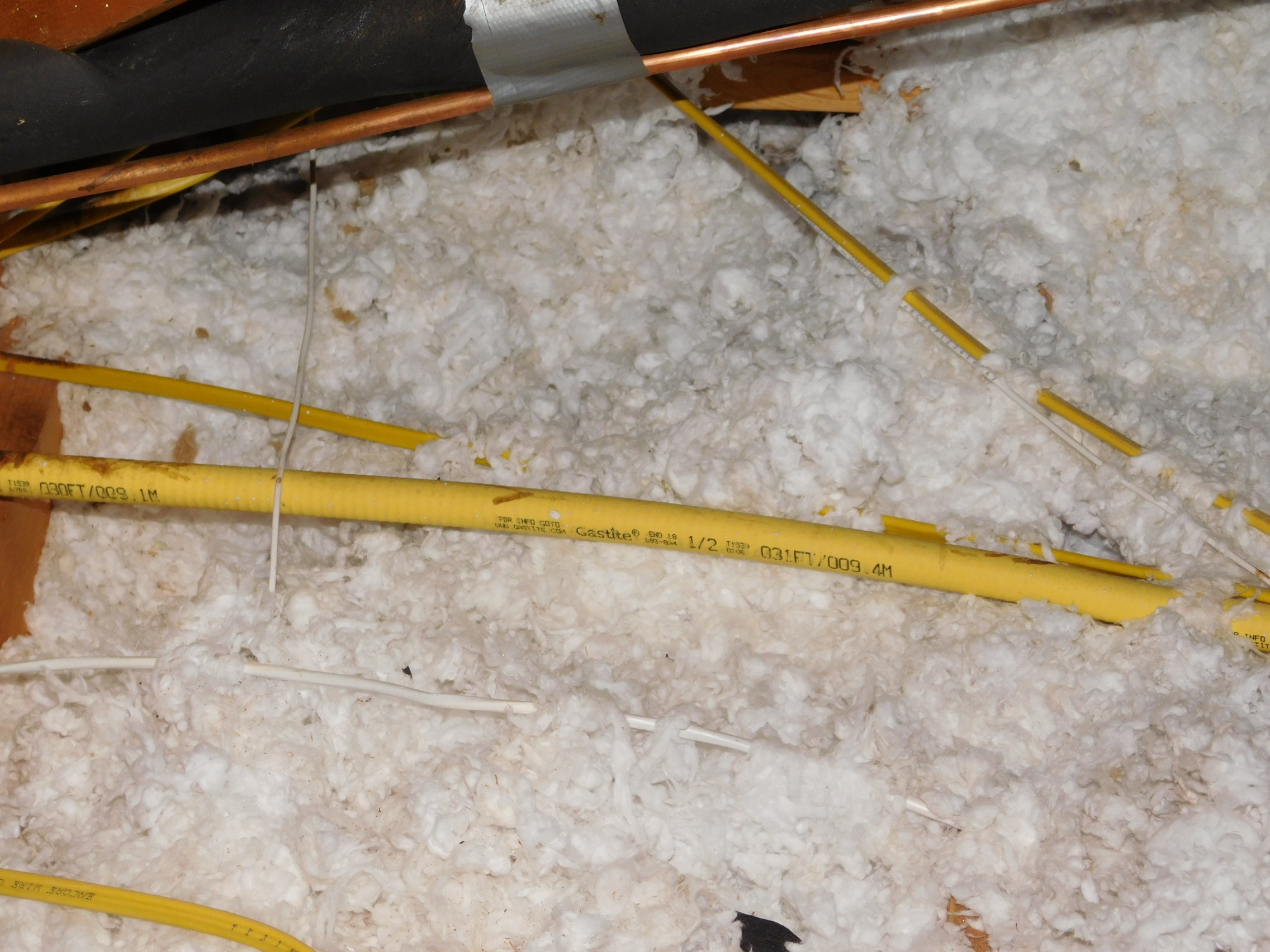
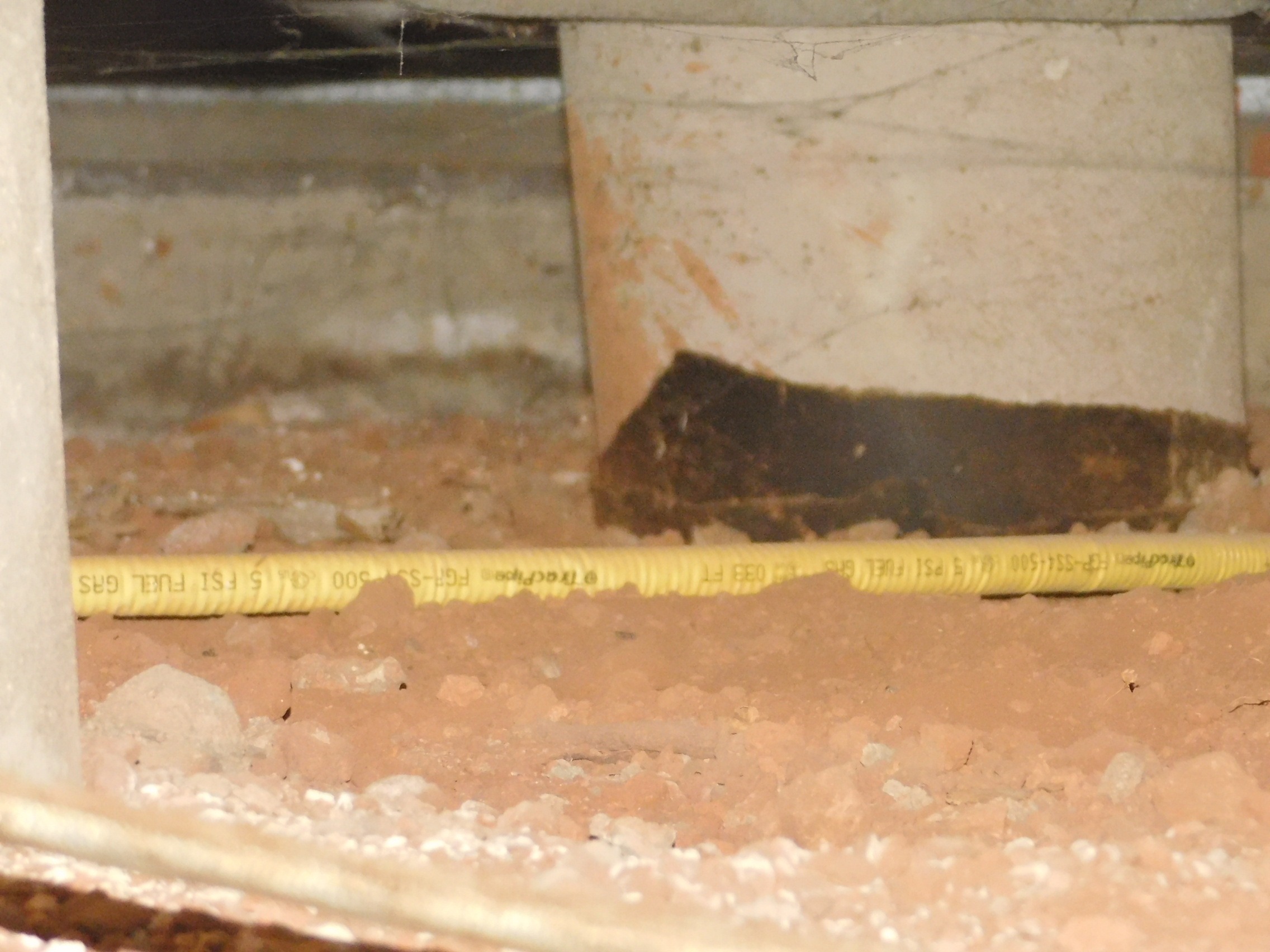
Corrugated Stainless Steel Tubing is fairly easy to identify. It is a corrugated tubing that is almost an inch in diameter. It almost always has a yellow plastic coating on it. Some of the best places to look for CSST is in your attic, basement, or in the crawlspace underneath your home. NOTE: Do not confuse CSST with the smaller, shorter yellow gas lines that run from the gas valve to your furnace, water heater, and stove. These gas lines are not Corrugated Stainless Steel Tubing, and they are considered safe.
Below are some examples of typical CSST in attics and crawlspaces.



If you are unsure if you have CSST in your home, a licensed plumber should be able to do a quick inspection and let you know if it’s present.
What Should You do if You Have CSST in Your Home?
If you do have CSST, don’t panic. All you need to do is to call an electrician and have them determine if it has already been bonded. If it hasn’t been bonded, have them bond it, and then you should be all set. Here is a photo of some properly bonded CSST.

Another thing that you can do if you find CSST in your home is to ensure that it is not sitting close to any metal that could allow it to arc. This means that no wiring or copper water lines should run over or under it, and that it should not be sitting on or against anything that could cause arcing such as your furnace, water heater, or the condensate pan under the furnace in the attic. Below is a photo of wiring crossing over the CSST. This situation can be made safe by moving this wire away from the Corrugated Stainless Steel Tubing.

In summary, CSST has been responsible for some fires, but it is responsible for a very small percentage of home fires that have occurred over the last 30 years. It should be safe as long as it is installed properly and bonded correctly. When it comes to protecting your home from fire, there are a lot of other things that you should worry about more such as being more careful while cooking, burning candles, heating your home, using your fireplace, and smoking.
For more information on home plumbing systems, check out our blog on Plumbing Vents.
© 2020 Mike Morgan
This article was written by Mike Morgan, the owner of Morgan Inspection Services. Morgan Inspection Services has been providing home, septic and well inspection services throughout the central Texas area since 2002. He can be reached at 325-998-4663 or at mike@morganinspectionservices.com. No article, or portion thereof, may be reproduced or copied without prior written consent of Mike Morgan.