
There is a lot of discussion in the home inspection industry about what is the best way to test electrical receptacles. I have spoken to some old-time home inspectors who used to check receptacles by plugging a lamp into them. If the lamp came on, then the receptacle was “good.”
We have come a long way since then. Today, we can use multimeters, non-contact voltage detectors, three-light testers, circuit analyzers, etc. They each have their pros and cons which I discuss briefly below.
A Multimeter- Testing Electrical Receptacles
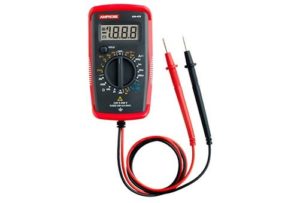 When it comes to testing electrical receptacles, a multimeter can accurately tell you how much voltage you have between two slots of a receptacle. However, it will not tell you which of those two slots is the “hot” slot, and which of those two slots is the neutral slot.
As a result of this, you will get the same indication on both a properly-wired receptacle, and a receptacle with reverse polarity (hot and neutral reversed) when you use a multimeter to check the voltage between the hot and the neutral slots.
You can always check the voltage between the hot and the ground slots, and between the neutral and the ground slots to determine if the polarity is correct; however, this technique only works if the receptacle is grounded.
On an ungrounded receptacle, ALL your multimeter can tell you is that you have voltage between the hot and neutral slots, but not which side is hot and which is neutral, so you would be missing some potentially critical information.
One drawback to using a multimeter is that it takes more time than using something like a three-light tester – especially if you’re going to be checking all three pairs of slots in each receptacle.
Non-Contact Voltage Detector
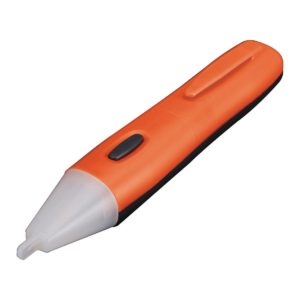 Non-contact voltage detectors, or voltage sniffers as some people call them, use the principle of capacitance to determine if a wire or a slot is hot. They are very good at indicating which slot is hot, and which is not. They cannot tell you how much voltage is on the wire or slot that is being tested.
They also have a tendency to pick up voltages that are induced from other nearby sources. Therefore, they can indicate voltage when there is not actually voltage on the wire being tested.
Three-Light Testers for Testing Electrical Receptacles
Three-light testers are probably the tool used by most home inspectors to test electrical receptacles. Using them is quick and easy; however, they have several drawbacks that home inspectors should be aware of. 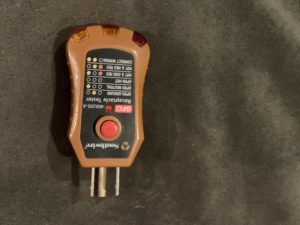
First of all, they can only identify and indicate one problem on a given receptacle. If you have a receptacle with multiple issues, the three-light tester will only indicate one of those issues.
For example, if you have a receptacle with an open ground and with reverse polarity, the three-light tester will only indicate the open ground. You will have no idea that the receptacle also has been wired with reverse polarity.
Another limitation of three-light testers is that they can give false indications. Since they cannot determine which slot has voltage and which slot is at ground or zero volts, they can sometimes give the wrong indication. (SEE MY POST ABOUT HOW THREE-LIGHT TESTERS WORK)
One example of this limitation is that they are unable to recognize a receptacle with reverse polarity if the receptacle is not grounded. This is because they do not have the reference point of the ground to compare the other two slots to in order to determine which of the two slots is hot and which is neutral.
Another example of an inaccurate indication is they will indicate that a properly wired receptacle with an open neutral somewhere upstream is a Hot/Ground reverse – a very incorrect reading caused by the fact that they cannot identify which wire is hot and which is neutral. (SEE MY POST ON HOT/GROUND REVERSES)
Circuit Analyzer
A circuit analyzer is probably the most accurate test device for testing electrical receptacles. The circuit analyzer with which I am most familiar is the SureTest circuit analyzer model 61-164 from Ideal Industries. This device will tell you if the receptacle is wired properly but it, too, cannot identify multiple wiring defects in the same receptacle.
It is the only device mentioned in this post that can identify a false or bootleg ground. It can determine voltage drops in wiring. It will not only test a GFCI-protected receptacle, but it will also tell you how fast the GFCI tripped. All in all, it is a very good tool. It is capable of doing a lot more analyzing than a home inspector needs to do.
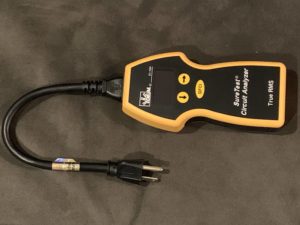 One drawback of these Ideal SureTest circuit analyzers is that they are the most expensive device discussed in this post. They cost just over $300. This is compared to less than about $10 – $20 for any of the other test devices mentioned above.
Another drawback to some circuit analyzers (including the Ideal SureTest) is that they take 10 – 15 seconds to test each receptacle. This is compared to an instantaneous reading on all of the other test devices.
Adding to the testing time is the fact that you are also supposed to wait about 20 seconds after testing one receptacle before you test the next one. This interval gives time for the voltage in the device to dissipate, thus allowing it to give an accurate reading on the next receptacle.
(SEE MY POST THAT COMPARES THE READINGS OBTAINED ON A THREE-LIGHT TESTER TO THE READING ON A SURETEST CIRCUIT ANALYZER FOR MANY DIFFERENT WIRING CONFIGURATIONS.)
What Receptacle Tester Should a Home Inspector Use?
There is no right or wrong answer here.
Perhaps a combination of tools such as a three-light tester and a non-contact voltage detector would work. With these two, you could at least identify some multiple deficiencies in an individual receptacle.
I inspect in Texas, and our Standards of Practice require us to write up as deficient “deficiencies in receptacles.” This is a rather vague statement left open to a lot of interpretation. Most inspectors to whom I have spoken use the three-light tester, which we know will not identify all deficiencies in a given receptacle – if there are multiple deficiencies.
Personally, I believe that if the inspector identifies and calls out a deficiency on a receptacle, even if they do not identify and call out all deficiencies, that they are essentially fulfilling the requirements of the SOPs.
If an electrician is called in to fix that deficiency, he or she should recognize the other deficiency after the one noted in the report is corrected.
In the case of an older house where nothing is grounded, these three-light testers are useless to identify most other deficiencies. In most cases, a three-light tester will just tell you that the receptacle has power but that it is not grounded.
You will never find a receptacle with reversed polarity in the older house mentioned above if all you use is a three-light tester.
Using a three-light tester along with a non-contact voltage detector in a home with all open grounds will allow the inspector to perform a more thorough inspection of the home’s electrical system.
If you are only going to use one tool, I would choose the three-light tester. The three-light tester will identify most deficiencies, so I think it is the most useful, reasonably priced tool that home inspectors can use to test receptacles.
If you do choose to use only a three-light tester, it is important that you understand its limitations which I have discuss here and in the other post linked to above.
Bootleg Ground
The one significant (but somewhat rare) deficiency that the three-light tester will not detect (even if there are no other deficiencies with the receptacle) is a false or bootleg ground.
In short, a bootleg ground is where someone has run a jumper between the neutral and ground screw in order to make the receptacle appear to be grounded. A bootleg ground does not properly ground the receptacle, and it actually creates a dangerous situation. (See my post about bootleg grounds.)
While a bootleg ground is fairly uncommon, it is also a potentially dangerous situation.
In my experience, I believe that this is not something that most inspectors specifically look for on every receptacle in the home. There is no simple, cheap, and quick method for identifying these.
I think inspectors should at least be aware of what they are, their dangers, and some warning signs of the possible presence of a bootleg ground in the home.
How to Identify Bootleg Grounds without a Suretest Circuit Analyzer
This technique applies to older homes that were built prior to grounding being required. You shouldn’t expect to find a bootleg ground in a newer home that is wired with a three-wire system.
If there is a bootleg ground in a newer home for some crazy reason, it would be difficult to know about it without using a SureTest circuit analyzer or removing the cover plate from every single receptacle in the home. This is not something that a home inspector is going to do.
Here is what I suggest that you do when inspecting an older home that was likely wired with a two-wire system.
- When you remove the cover from the breaker panel, look for ground wires. If there are no ground wires or if there are only very few ground wires in the panel, you would expect there to be no or very few grounded receptacles in the home.
- Once you start testing the receptacles, if you see more grounded ones than you would expect based on the number of ground wires that you saw in the panel, you should suspect that there may be some bootleg grounds.
- At this point, pull out your SureTest circuit analyzer and check for bootleg grounds on the receptacles that are showing to be grounded.
If you are not ready to plop down $300+ on a SureTest circuit analyzer, then there is really only one way to check for a bootleg ground without one.
Remove the cover plate and look for a jumper wire running from the ground screw to the neutral screw. You may have to pull the receptacle out of the wall to see the jumper wire, so this could be time consuming, but if you are only checking a few random receptacles, it shouldn’t take too long.
I’m not necessarily suggesting that you start pulling receptacles out of walls as part of a home inspection. I’m just telling you that this is one way to find a bootleg ground.
Summary- Testing Electrical Receptacles
It’s important to understand the limitations of the tools that you use. Understanding the pros and cons of these tools will help you to make an informed decision about how you can provide the best inspection for you clients.
© 2021 Mike Morgan
This article was written by Mike Morgan, the owner of Morgan Inspection Services. Morgan Inspection Services has been providing home, septic and well inspection services throughout the central Texas area since 2002. He can be reached at 325-998-4663 or at mike@morganinspectionservices.com. No article, or portion thereof, may be reproduced or copied without prior written consent of Mike Morgan.