
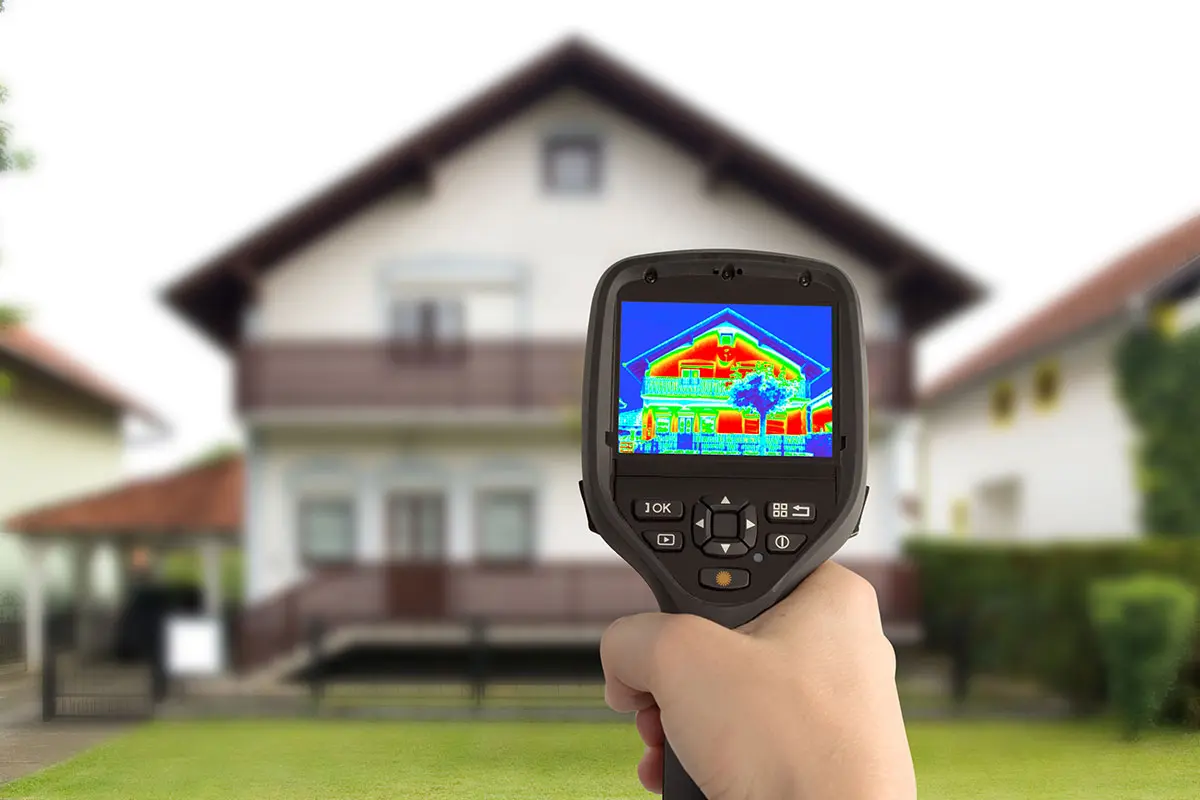
What a thermal scan can and cannot tell you
We'll be straight with you, because there's a lot of hype around these cameras. People picture something like an X-ray that shows pipes, studs, and mold behind the drywall. That's not how it works. The camera measures heat coming off a surface and turns it into a color picture. Warm areas show up one color and cool areas show up another. Everything it tells you comes from those differences.
That sounds simple, but it's useful. A lot of problems in a house change the temperature of the surface in front of them before you can see any damage.
- Water leaks. Wet drywall or flooring usually reads cooler because the water is evaporating. A cool patch under a window or below a bathroom can show up before you'd ever see a stain.
- Missing or settled insulation. Gaps in the attic or in a wall show up as a hot or cold patch, depending on the season.
- Air leaks. Drafts around doors, windows, attic hatches, and outlets show up as streaks where outside air is getting in.
- Electrical hot spots. A breaker or wire connection that's running hotter than the ones next to it can be a sign of a loose connection or an overloaded circuit.
- Heating and cooling issues. You can see whether a vent is putting out the air it should, or whether a duct is leaking into a wall or attic.
Here's the other side, and it matters just as much. A thermal camera can't confirm that a spot is wet. It can only show you that it's cool. That cool spot could be a leak, but it could also be a draft, a duct running behind the wall, or the shadow of a cold night on an outside wall. That's why a moisture meter or a closer look should always follow up on anything suspicious. The picture raises the question. It doesn't answer it.
- It can't see through walls, floors, or ceilings. It only reads the surface.
- It can't identify mold. It can point to moisture that might lead to mold, and that's all.
- It can't find an old leak that has already dried out. If there's no temperature difference, there's nothing to see.
- It can't look inside your drain lines. That takes a camera that goes down the pipe, which is what a sewer line scope is for.
- It can be fooled by shiny surfaces. Metal, glass, and glossy tile reflect heat from other things, so a reading off them isn't always what it seems.
Conditions matter too. The camera works best when there's a good temperature difference between inside and outside the house. On a mild day with the windows open, insulation gaps and air leaks can be hard to pick out. On a hot afternoon with the air conditioner running, or a cold morning with the heat on, those same problems tend to stand out clearly.
So the honest way to think about it is this. Thermal imaging is a very good tool for finding where to look. It isn't a verdict on its own. Paired with someone who understands how a house's systems work together, it can catch things you'd otherwise find months later as a stain on the ceiling.
When thermal imaging catches what a visual inspection misses
A good visual inspection catches a lot. But it can only report what's showing. Thermal imaging helps most when a problem is real and active but hasn't made its way to the surface yet. Here are the times it tends to make the biggest difference.
Fresh paint over an old stain. When a house goes on the market, it's common for walls and ceilings to get a fresh coat. That's not always hiding anything. Sometimes it's just good staging. But paint covers a water stain just as well as it covers a scuff. If the leak that made the stain is still active, the area behind that new paint can still read cooler than the wall around it. Your eyes see a clean ceiling. The camera sees a reason to grab the moisture meter.
Leaks that haven't soaked through yet. A slow drip from a shower valve, a supply line behind a kitchen cabinet, or a drain under an upstairs tub can wet the inside of a wall for weeks before a stain shows up. By the time you can see it, the drywall and framing have been wet for a while. Finding it early usually means a smaller repair.
Places nobody can safely reach. Some spaces can't be fully walked or seen, like low attics, vaulted ceilings with no attic above them, and the far corners past the ductwork. A scan of the ceiling from below can show where insulation is missing or where a duct is dumping cooled air into the attic instead of the room.
An electrical panel that looks fine. Breakers don't change color when a connection starts to loosen. A panel can look neat and still have one breaker running noticeably warmer than its neighbors. That's not something you'd ever spot by looking, and it's worth having an electrician check.
Warm spots in a floor. A hot water line leaking under a slab can sometimes show up as a warm patch on the floor above it. You'd never see that just by walking across the room.
None of these are the camera solving the problem by itself. In every case, the picture shows where something's off, and then somebody has to figure out why. That second step is where training matters. Mike Morgan studied chemical engineering at Texas Tech before he ever inspected a house. That background makes him want to understand how heat, air, and water move through a building, not just notice that a spot looks blue on a screen. He's a curious person by nature, and a strange cold patch is the kind of thing he'll keep digging into until it makes sense.
For most people, the best time to use thermal imaging is alongside a full home inspection in Brownwood, before you close on a house. That way the scan and the visual check work together. One shows what's visible, and the other shows what's hiding behind the paint and drywall.
Why Brownwood's temperature swings make scans more effective
The camera needs a temperature difference to work with, as mentioned above. Brownwood weather tends to supply one for a good part of the year. Our summers are long and hot, and our winters bring cold fronts that can drop the temperature fast. That gives a scan plenty of contrast during the months when you'd most want to know how a house is holding up.
Here's what that looks like in practice.
- Summer afternoons. The sun bakes the roof and the attic gets very hot, while the air conditioner keeps the rooms below cool. If insulation is thin or missing in one area, that heat comes straight through, and the ceiling shows a warm patch you can't feel just by standing under it. A duct leaking cool air into the attic stands out the same way.
- Mornings after a cold front. When a norther blows in overnight and the heat is running, drafts around windows, doors, and attic hatches show up as cold streaks. Gaps in wall insulation stand out against the warmer wall around them.
- Right after a hard rain. Spring storms here can be heavy. If a roof flashing or a window seal is letting water in, the wet area tends to read cooler for a while after the storm passes, before it has a chance to dry out.
The harder days are the mild ones. On a pleasant spring or fall day with the windows open, inside and outside are close to the same temperature, and some insulation and air leak problems can blend in. A scan can still help then. Electrical hot spots don't depend on the weather, because the heat comes from the circuit itself. But it's worth knowing that a soft fall afternoon won't show attic insulation as clearly as a July one.
If you've lived around here a while, you know you don't always get to choose your weather. Sometimes it changes between lunch and supper. When you're buying a house, the closing date usually sets the schedule, not the forecast. That's fine. A few simple steps will help the scan show as much as it can on whatever day you get.
- Make sure the utilities are on. Vacant houses for sale sometimes have the power or gas shut off. Without them, there's no air conditioning or heat running to create the difference the camera reads.
- Let the heating or cooling run for a few hours beforehand. A house that was closed up and off all week needs time to settle back to normal.
- Keep the windows and doors shut that day so outside air doesn't wash out the readings.
- Mention any past stains, roof repairs, or rooms that always run hot or cold. That tells your inspector where to look closer.
None of this calls for waiting on perfect conditions. It's about getting the most out of the day you have. A house that has already been through a Brownwood summer or a hard winter freeze has also been tested by it, and the scan is a good way to see how it did.
Thinking about a thermal imaging in Brownwood? Let's talk.
Call (325) 510-3305 · report within 24 hours
Matching thermal imaging to the right inspection type
Every home inspection we do includes a quick, general thermal scan. A more detailed, thorough scan is a separate thermal imaging inspection with its own charge. Either way, thermal imaging is a tool that makes other inspections sharper. How much it adds depends on what you're inspecting and why. Here's how we'd think about it for each situation.
- Buying a home. This is where it earns its keep. You get one look before you sign, and the scan helps catch what's behind the paint while you can still negotiate a repair.
- Selling a home. A pre-listing inspection with a scan lets you find a slow leak or an insulation gap before the buyer's inspector does. Fixing it on your schedule is usually cheaper and calmer than fixing it in the middle of a deal.
- New construction. On a finished new house, the camera is good at spotting insulation that got skipped behind a wall or a duct that was never fully connected in the attic. Those are easy mistakes to make when a crew is moving fast, and they're hard to see once the drywall is up.
- 11th-month inspections. If your home is still under the builder's first-year coverage, this is a good time for a scan. You've lived through most of a year of heat and cold, and any insulation or duct problem has had time to show itself.
- Manufactured homes. The ducts often run under the floor, where they're hard to reach. A scan of the floor vents and ceilings can show whether air is making it to every room or leaking out somewhere along the way.
- Rentals and multi-unit buildings. A leak in one unit can quietly wet the wall or ceiling of the unit next to it or below it. Scanning shared walls and ceilings can catch that before a tenant calls about a stain.
- Commercial buildings. Offices, retail spaces, restaurants, and warehouses usually have bigger electrical panels and large, low-slope roofs. The camera is useful for finding a warm breaker or a wet spot on a ceiling under a roof that's hard to walk.
There's one place where we'd tell you the camera doesn't add much. During a pre-drywall inspection, the walls are still open. The inspector can look right at the insulation, the pipes, and the wiring. You don't need a heat picture to guess what's behind the wall when there's nothing in front of it yet. The scan makes more sense later, once the house is closed up and the heating and cooling are running.
It also helps to know what thermal imaging won't replace. If you're worried about your drain line, a sewer line scope is the right tool. If you're worried about termites, a termite inspection, performed by our licensed partner, is what answers that question. A heat picture might hint that something's off in those areas, but it can't confirm either one.
If you're not sure which inspection fits, that's a normal place to be. Tell us what you're buying, selling, or building, and what's worrying you about it. Mike Morgan holds TREC license #6231, and we're happy to walk you through what makes sense for your house and what you can skip.
When thermal imaging is not necessary
Not every house needs a thermal scan. We'd rather tell you that up front than have you pay for something that won't help. Here are the times we'd tell a friend to skip it, or to put that money somewhere else.
- You can already see the problem. If water is dripping from the ceiling, or a stain gets bigger after every rain, you don't need a camera to tell you there's a leak. You need a roofer or a plumber to find the source and fix it. A heat picture of a leak you can already see won't make that repair any smaller.
- The walls are coming out anyway. If you're buying a house you plan to gut down to the studs, the drywall and insulation are headed for the dumpster. Once it's open, you and your contractor can look right at the framing and pipes. Put your inspection money toward the things that will stay, like the foundation, the roof, the plumbing, and the electrical service.
- You're buying land or an empty lot. With no building, there's nothing to scan. If the property has a well or a septic system, a well system inspection or a septic system inspection will answer the questions that matter there.
- You want to know if there's mold. As mentioned earlier, the camera can't identify mold. If you notice a musty smell or see growth on a wall, mold testing by someone who does that work is the right next step.
- You're chasing one drafty window in the house you live in. If you just want to know why the back bedroom stays cold all winter, you can often find the draft yourself on a cold, windy day by moving the back of your hand slowly around the window frame and trim. Hardware stores also sell small thermal cameras that clip onto a phone. They aren't as sharp as an inspection camera, but for one draft in your own home, they can be enough.
- The house can't be heated or cooled on inspection day. If the utilities can't be turned on before closing, a scan will mostly show a house that's the same temperature as the air outside. It's worth knowing that before you add it on.
There's one more case worth a sentence. If a qualified contractor has already opened up an area, found the cause, and fixed it, a scan of that same spot won't tell you much more than their work already did. A scan helps more on the parts of the house nobody has looked at.
Skipping the scan in these situations isn't cutting corners. It's picking the right tool for the job. A thermal camera is worth the most when a house looks fine and you need to know whether it really is. That's the whole reason to use one. When you already know what's wrong, or nothing behind the walls is going to survive the remodel, your time and money will do more good somewhere else.
If you're on the fence, tell us about the house and what you plan to do with it. We'll give you a straight answer on whether a scan is worth it, even if the answer is no.